OBD-II Mega list
OBD2 Codes: Full List, Meaning, Fixes, and Free Download
Got a diagnostic trouble code and want to know what it it?
This post covers OBD2 Codes divided into 4 groups: 1-Powertrain – Pxxx, 2-Network – Uxxx, 3-Body – Bxxx, and 4-Chassis – Cxxx). You will also find their meanings, causes, symptoms, and how to fix them. We also offer a free codes list for download.
Table of Contents [show]
What is an OBDII Code?
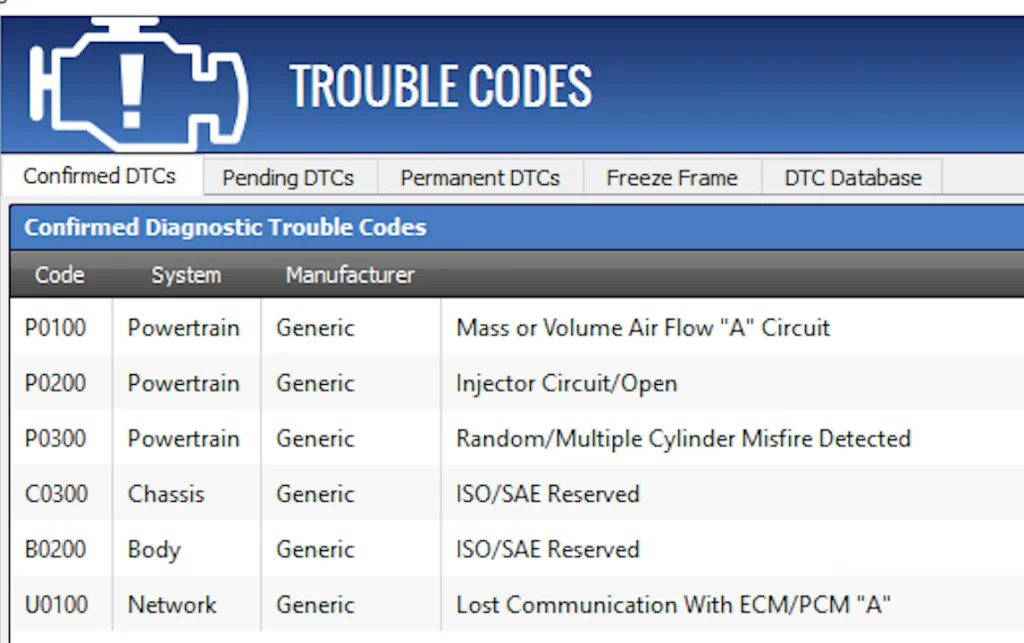
OBD is short for onboard diagnostics. It refers to a vehicle’s electronic system that performs self-diagnosis and reporting. Whenever a problem is detected the system records it as a unique code. That code is known as a diagnostic trouble code (DTC). As a vehicle owner or mechanic, you can pull that code and interpret it to understand the nature of the problem. For example, if the car gives you the P0201 code, it means that there’s a malfunction in cylinder 1 of the injector circuit. Your job is to pinpoint the issue and fix it.
Now, with that in mind, OBDII codes are trouble codes specific to OBD2 vehicles. These are generally cars, SUVs, light trucks, etc. that are made and/or sold in the US since 1996. In other words, if a car is a 1996 or newer model, it is OBD2-compliant. And that also means that it uses OBD-II codes to do self-diagnosis and reporting.
I’ll be using all three interchangeably all through the post, be sure not to get confused.
How to Interpret the Letters and Digits in an OBD2 Code?
OBD provides monitoring for various systems. They include the engine control module, body, chassis, etc. When you look at the code, you can immediately tell which system has a fault-based on how it appears.
Here’s a breakdown.
The First Character (Letter)
All OBDII codes start with a letter that denotes the part of the vehicle that has a fault. Let’s look at each letter, shall we?
P – Powertrain. It includes the engine, transmission and all the associated accessories.
U – Network & Vehicle Integration. These are functions that are managed and shared by onboard computer systems.
B – Body. These are parts mainly found in the passenger compartment area.
C – Chassis. It covers mechanical systems and functions like steering, suspension, and braking.
The Second Character (Number)
The first letter is usually followed by a number. This number can only be ‘0’ or ‘1’.
0 – If it’s a ‘0’, ‘2’, or ‘3’ then the code is a standardized (SAE) code; also known as generic code
1 – If it’s a ‘1’ then you’re looking at a manufacturer-specific code
The Third Character (Number/Letter)
This number denotes the particular vehicle system that has a fault. There are eight systems in total:
0 – Fuel and air metering and auxiliary emission controls
1 – Fuel and air metering
2 – Fuel and air metering (injector circuit)
3 – Ignition systems or misfires
4 – Auxiliary emission controls
5 – Vehicle speed control and idle control systems
6 – Computer and output circuit
7 – Transmission
A-F – Hybrid Trouble Codes
The Fourth And Fifth Characters (Number)
The
final piece of a DTC is a two-digit number. This number defines the
exact problem that you’re dealing with. It can be any number between 0
and 99.
As you can see a typical DTC has five characters in total,
and each one of those characters gives it a description. For example, if
you get the code P0219, it means that the car has an engine over-speed
condition.
The ‘P’ means that the problem is in the powertrain. The ‘0’ means that it’s a generic code while the ‘2’ refers to the fuel and air metering (injector circuit) system. The last two digits (19) define the problem; i.e., an over-speed condition.
Want to know more about codes and their meanings? Below comes a more comprehensive OBD codes list.
As mentioned already, DTC codes that start with ‘P’ relate to the powertrain. Those that start with ‘U’ are for the network and vehicle integration system. Codes whose first character is ‘B’ relate to the vehicle’s body while ‘C’ codes are for the chassis.
OBD2 Codes List for FREE Download
Generic Powertrain OBD2 Trouble Codes
- P0001 through P0099
- P0100 through P0199
- P0200 through P0299
- P0300 through P0399
- P0400 through P0499
- P0500 through P0599
- P0600 through P0699
- P0700 through P0799
- P0800 through P0899
- P0900 through P0999
- P0A00 through P0AFF
- P0B00 through P0BFF
- P0C00 through P0F00
- P2000 through P2099
- P2100 through P2199
- P2200 through P2299
- P2300 through P2399
- P2400 through P2499
- P2500 through P2599
- P2600 through P26A2
- P2700 through P2799
- P2800 through P2899
- P2A00 through P2F00
- P3000 through P3F00
- Full Powertrain Code List
Generic Chassis, Network, and Body Codes
Manufacturer-Specific Codes
- Acura codes
- Audi codes
- BMW codes
- Chevrolet codes
- Dodge/Chrysler/Jeep codes
- Ford Codes
- Honda Codes
- Hyundai Codes
- Infiniti Codes
- Isuzu Codes
- Jaguar Codes
- KIA Codes
- Land Rover Codes
- Lexus Codes
- Mazda Codes
- Mitsubishi Codes
- Nissan Codes
- Subaru Codes
- Toyota Codes
- VW Codes
OBD2 Codes: Meaning, Causes, and Fixes
Below comes the details of all OBDII codes.
But if you want to find your codes right away, jump to the appropriate code lists that contains meaning, symptoms, causes, and fixes!!
P0010 Intake Camshaft Position Actuator Circuit / Open (Bank 1)
The P0010 code happens when bank 1 camshaft and the crankshaft have a variation in mechanical timing. The problem occurs when the engine experiences high RPM. The ECM doesn’t properly adjust valve lift at high RPM.
Main Symptoms:
- Check Engine Light comes on
- Engine performs poorly at high RPM
- Car runs roughly
- Lower fuel economy
- Car fails emission test
Possible Causes:
- Sludge in engine oil
- Faulty OVC (oil control valve)
- Internal damage to ECM
- ECM timing is out of sync
- Wiring damage
- Malfunction of crankshaft or camshaft sensor
- A short in VCT/VVT circuit, or the circuit is open
Diagnostic Steps:
- Use an advanced diagnostic tool to pull engine codes
- Inspect the VVT/VCT solenoid system for dirty oil
- Inspect the circuit for wiring problems
P0011 Intake Camshaft Position Timing – Over-Advanced (Bank 1)
The P0011 code is triggered when the camshaft timing for bank 1 is above and beyond the limit set by the ECM. This causes an over-advanced condition that occurs either during retarding or advancing of the camshaft timing.
Main Symptoms:
- Check Engine Light comes on
- Hard starting
- Poor idle
- Car may run rough or stall
- Poor fuel economy
- Car may fail emission test
Possible Causes:
- Camshaft remains advanced despite ECM commanding it to retard
- Bank 1 oil control solenoid may be clogged or stuck
- Oil may be too thick and is thus blocking passages in bank 1
- Wiring problems in VCT/VVT
- Oil continuously flows to VCT piston chambers open
Diagnostic Steps:
- Check that engine oil is clean and has the recommended viscosity
- Visually inspect wiring in the CVT system
- Pull engine codes and live data using advanced diagnostic tool
P0012 Intake Camshaft Position Timing – Over-Retarded (Bank 1)
The P0012 code is triggered when bank 1 is having an over-retarded timing condition that occurs either during retarding or advancing.
Main Symptoms:
- Check Engine Light comes on
- Hard starting
- Poor fuel economy
- Car may run rough or stall
- Car may fail emission test
Possible Causes:
- Camshaft timing is incorrect
- Wiring problems in VCT/VVT
- Oil continuously flows to VCT piston chamber
- Timing valve solenoid control has failed and is stuck in open position
- Oil may be too thick and is thus blocking passages in bank 1
Diagnostic Steps:
- Check that engine oil is clean
- Visually inspect wiring in the CVT system
- Pull engine codes and live data using advanced diagnostic tool
- Using bidirectional scanner, command the timing valve solenoid control valve to open and close then see if camshaft timings change. If they change it means the valve is not the problem
P0014 Exhaust Camshaft Position Timing – Over-Advanced (Bank 1)
The P0014 code happens when bank 1 camshaft is having an over-advanced timing condition that occurs either during retarding or advancing.
Main Symptoms:
- Check Engine Light comes on
- Hard starting
- Poor fuel economy
- Car may run rough or stall
- Car may fail emission test
Possible Causes:
- Camshaft timing is incorrect
- Wiring problems in VCT/VVT
- Oil continuously flows to VCT piston chamber
- Timing valve solenoid control has failed and is stuck in open position
- Oil may be too thick and is thus blocking passages in bank 1
Diagnostic Steps:
- Check that engine oil is clean and full in the tank
- Visually inspect wiring in the CVT system
- Pull engine codes and live data using advanced diagnostic tool
- Using bidirectional scanner, command the timing valve solenoid control valve to open and close then see if camshaft timings change. If they change it means the valve is not the problem
P0016 Crankshaft Position Camshaft Position Correlation Bank 1 Sensor A
The P0016 code occurs when the crankshaft and camshaft signals are out of time. Meaning the ECM can detect that the timing of the crankshaft and that of the camshaft do not correlate.
Main Symptoms:
- Check Engine Light comes on
- Engine may crank but fail to start
- Engine may continue to run but will record poor performance
- Rattling sound in the harmonic balancer
- Poor fuel economy
Possible Causes:
- Timing chain is overstretched
- Tone ring on camshaft and/or crankshaft is has slipped or broken
- Timing chain has jumped teeth and put camshaft timing out of position
- Problems with camshaft phaser and putting the phaser out of position
- Wiring to crank/cam sensor is damaged
Diagnostic Steps:
- Inspect oil control valve (OCV) for connection or wiring problems
- Check that engine oil is clean, full and has correct viscosity
- Pull engine codes and live data using advanced diagnostic tool
- Using bidirectional scanner, command the OVC on and off then see if camshaft timings change. If they change it means the valve is not the problem
P0037 Heated Oxygen Sensor (H02S) Heater Control Circuit Bank 1 Sensor 2
The P0037 code is triggered when bank 1, sensor 2 of the O2 sensor heater circuit is faulty. As such, the engine isn’t achieving closed loop and therefore the car has increased emissions.
Main Symptoms:
- Check Engine Light comes on
- Longer time needed to achieve closed loop
- Decreased fuel economy
- Engine may go into fixed fuel mix
Possible Causes:
- H02S sensor in bank 1, circuit 2 is not sending the correct signal to ECM
- Damaged or failed element in heater circuit
- Open in O2 sensor heater’s circuit
- Open/short in O2 sensor heater’s battery
- Defective ECM (this is the least likely cause)
Diagnostic Steps:
- Inspect wiring and power to the O2 sensor and ensure there’s no damage/open/short
- Use code reader to pull engine codes
- Check voltage of O2 sensor and ensure it matches manufacturer’s specs
- Replace O2 sensor if necessary
P0102 Mass or Volume Air Flow Circuit low Input
The P0102 code happens when the mass airflow (MAF) sensor is not performing within the normal expectation and is therefore sending a lower signal than normal (due to low voltage).
Main Symptoms:
- Check Engine Light comes on
- Extremely low fuel consumption and thus internal engine problems
- Engine runs roughly
- Car idles and stalls frequently
Possible Causes:
- Defective MAF sensor
- Presence of dirt and debris in MAF (restricts airflow)
- Leaks in air intake system
- Improper wiring of the circuit to MAF sensor
Diagnostic Steps:
- Use code reader to pull engine codes
- Visually inspect MAF sensor wiring and circuit
- Check for air leaks in air intake system
- Inspect MAF to see if there’s dirt and debris
P0106 Manifold Absolute Pressure/Barometric Pressure Circuit Range/Performance Problem
The P0106 code is triggered when the Powertrain Control Module (PCM) has not detected a change in engine speed, throttle angle and/or exhaust gas recirculation (EGR) despite an increase in manifold absolute pressure (MAP). Increase in MAP indicates increase in engine load.
Main Symptoms:
- Check Engine Light comes on
- Poor fuel economy
- Engine fails to idle
- Engine produces black smoke (visible at tailpipe)
- Erratic acceleration
Possible Causes:
- Faulty MAP sensor
- Air intake component is loose, cracked or doesn’t have its plastic fitting
- Water or dirt affecting connector to MAP sensor
- Corrosion may be causing poor signal to and from MAP sensor
- PCM is defective (least likely but not unlikely)
Diagnostic Steps:
- Use an advanced scanner to pull engine codes
- With that scanner, take the reading of MAP sensor when engine is off but key is on. It should be similar or close to barometric pressure (BARO) reading
- Start the engine and see if MAP sensor readings drop significantly. If they do the sensor is working properly
P0113 Intake Air Temperature Circuit High Input (Sensor 1)
P0113 means that the signal voltage from the intake air temperature (IAT) is above 5V, which is more than the expected range.
Main Symptoms:
- Check Engine Light comes on
- Engine may run extra lean
Possible Causes:
- Defective IAT sensor
- Loose or faulty wiring at IAT sensor
- Open or short in IAT ground circuit, signal circuit or reference circuit
- PCM is defective (least likely but not unlikely)
Diagnostic Steps:
- Use an advanced scanner to pull engine codes.
- View live data from the IAT sensor. If the reading is less than -30 degrees then the sensor is likely to be faulty. If otherwise then it’s probably an intermittent problem
- Check the wiring for opens and loose connections
P0118 Engine Coolant Temperature Circuit High Input
P0118 means that the PCM has determined that ECT is less than freezing temp yet the engine has been running for several minutes, which shouldn’t happen.
Main Symptoms:
- Check Engine Light comes on
- Poor fuel economy
- Engine fails to idle and may not start completely
- Engine produces black smoke (visible at tailpipe)
Possible Causes:
- Defective ECT sensor
- Open or short in ECT signal or ground circuit
- PCM is defective (least likely but not unlikely)
Diagnostic Steps:
- Using an OBD2 scanner, check the reading of ECT. If it’s a logical reading then the problem is intermittent
- Perform a wiggle test while looking out for drop-outs. If there are any then there’s a bad connection to or from the ECT sensor
P0121 Throttle/Pedal Position Sensor/Switch A Circuit Range/Performance Problem
P0121 happens when the PCM has detected that the throttle position sensor (TPS) voltage is more or less than it should be for the current RPM.
Main Symptoms:
- Check Engine Light comes on
- Car produces black smoke (visible at tailpipe)
- Car stumbles when you accelerate or decelerate
- Engine may fail to start completely
Possible Causes:
- Defective TPS
- Open or short in TPS circuit
- Loose or bad connection to TPS
- PCM is defective (least likely but not unlikely)
Diagnostic Steps:
- Visually inspect all wiring to TPS for loose, open or short connections
- Using an OBD2 scanner, check for live and freeze frame data from TPS. If it doesn’t read .5 at idle and 4.5 at full throttle the TPS is faulty
P0122 Throttle/Pedal Position Sensor/Switch A Circuit Low Input
P0122 means that the PCM is reporting that the TPS has recorded a voltage that is lower than the normal minimum limit. The value varies from one car to another but the code may come when the voltage hits .20V or less.
Main Symptoms:
- Check Engine Light comes on
- Extremely high idle
- Rough or low idle
- Car stalls
- Acceleration is low or completely lacking
Possible Causes:
- Defective TPS
- Open or short in TPS circuit
- Improper mounting of TPS after replacement
- TPS has loosened
- PCM is defective (least likely but not unlikely)
Diagnostic Steps:
- Visually inspect all wiring to TPS for loose, open or short connections
- Check that TPS is tightly in position, especially if you recently replaced it
P0128 Coolant Thermostat (Coolant Temperature Below Thermostat Regulating Temperature)
P0128 OBD2 code shows that the PCM has detected that the engine has not attained the required temperature despite being on for enough time to attain that temperature
Main Symptoms:
- Check Engine Light MAY come on
- Engine temp drops when the vehicle is in high speed
- Engine takes abnormally long to warm
Possible Causes:
- Most likely cause is that thermostat is leaking or stuck in open position
- Engine coolant level is too low
- Defective IAT sensor
- Defective ECT sensor
- Defective cooling fan
Diagnostic Steps:
- Check whether coolant strength and level are in the recommended range
- Check whether IAT sensor, ECT sensor and coolant fan are working
- If all the above are okay then the thermostat is the problem
P0131 O2 Sensor Circuit Low Voltage (Bank 1 Sensor 1)
P0131 triggers when the ECM has determined that there’s a low voltage condition in bank 1 sensor 1; i.e. O2 sensor voltage remained too low for longer than 2 minutes.
Main Symptoms:
- Check Engine Light comes on
- Car produces black smoke (visible at tailpipe)
- Poor fuel economy
- Engine may fail to start completely
- If it starts it may run rough and/or stumble
Possible Causes:
- Mostly a problem related to corrosion, loose terminal or burnt wire in the O2 sensor 1 connector
- Defective O2 sensor
- Open or short in wiring to O2 sensor
- O2 circuit is experiencing high resistance
Diagnostic Steps:
- Visually inspect all wiring to O2 sensor 1 for loose, open or short connections
- Use a wiggle test to determine where the voltage drops out
- Using an OBD2 scanner, check whether sensor 1 of bank 1 is switching properly
P0133 O2 Sensor Circuit Slow Response (Bank 1 Sensor 1)
P0133 occurs when the O2 sensor or ECM can’t adjust air to fuel ratio as it’s supposed to even when the engine is running.
Main Symptoms:
- Generally doesn’t come with symptoms. However, in some cases the Check Engine Light may come on and fuel economy may reduce
Possible Causes:
- First O2 sensor in bank 1 is faulty
- Short, open or broken wire in O2 sensor circuit
- Exhaust leak
Diagnostic Steps:
- Visually inspect all wiring to first O2 sensor for loose, open or short connections
- • Use a wiggle test to determine where the voltage drops out
- • Visually check for exhaust leaks or air inlet leaks
- • Using an OBD2 scanner, check whether sensor 1 of bank 1 is switching properly
P0135 O2 Sensor Heater Circuit Malfunction (Bank 1 Sensor 1)
Usually, when O2 heater attains operating temperature, O2 sensor switches based on ambient temp. If ECM determines that the O2 sensor took too long to switch this code is set. It applies to the first sensor of bank 1
Main Symptoms:
- Check Engine Light comes on
- Poor fuel economy
Possible Causes:
- Short, open or broken wire in O2 heating system
- High resistance in O2 heater element or circuit
Diagnostic Steps:
- Visually inspect all wiring to first O2 sensor (bank 1) for loose, open or short connections
- Use a wiggle test to determine where the voltage drops out
- If the code is persistent replace O2 sensor
P0136 O2 Sensor Circuit Malfunction (Bank 1 Sensor 2)
P0136 means that the ECM has determined that the there’s a low voltage condition in bank 1 sensor 2; i.e. O2 sensor voltage remained too low for longer than 2 minutes.
Main Symptoms:
- Check Engine Light comes on
- Car produces black smoke (visible at tailpipe)
- Poor fuel economy
- Engine may fail to start completely
- If it starts it may run rough and/or stumble
Possible Causes:
- Mostly a problem related to corrosion, loose terminal or burnt wire in the O2 sensor 2 connector
- Defective O2 sensor
- Open or short in wiring to O2 sensor
- O2 circuit is experiencing high resistance
Diagnostic Steps:
- Visually inspect all wiring to O2 sensor 2 for loose, open or short connections
- Use a wiggle test to determine where the voltage drops out
- Using an OBD2 scanner, check whether sensor 2 of bank 1 is switching properly
P0137 O2 Sensor Circuit Low Voltage (Bank 1 Sensor 2)
Basically same as P0136. The P0137 is triggered when the PCM has detected that the O2 sensor may be inactive.
Main Symptoms:
- Generally doesn’t come with symptoms. However, in some cases the Check Engine Light may come on and fuel economy may reduce
Possible Causes:
- Faulty O2 sensor
- Short, open or broken wire in O2 sensor circuit
- Defective heater circuit in O2 sensor
- High resistance in O2 heater element or circuit
- Faulty fuel pump regulator resulting in very high or very low fuel pressure
- Exhaust leak
Diagnostic Steps:
- Visually inspect all wiring to O2 sensor for loose, open or short connections
- Use a wiggle test to determine where the voltage drops out
- Visually check for exhaust leaks or air inlet leaks
- If the code is persistent replace O2 sensor
P0138 O2 Sensor Circuit High Voltage (Bank 1 Sensor 2)
The P0138 code means heated O2 sensor in bank 1 sensor 2 is giving a higher voltage reading than it should. For most vehicles the code comes when voltage exceeds 1.5V.
Main Symptoms:
- Generally doesn’t come with symptoms. However, in some cases the Check Engine Light may come on and fuel economy may reduce
Possible Causes:
- Fuel temp is excessively high
- Short, open or broken wire in O2 sensor circuit
Diagnostic Steps:
- Visually inspect all wiring to O2 sensor for loose, open or short connections
- Use a wiggle test to determine where the voltage drops out
- Using an OBD2 scanner, check whether sensor 1 of bank 2 is switching properly
P0141 O2 Sensor Heater Circuit Malfunction (Bank 1 Sensor 2)
P0141 means when O2 heater attains operating temperature, O2 sensor switches based on ambient temp. If ECM determines that the O2 sensor took too long to switch this code is set. It applies to the second sensor of bank 1.
Main Symptoms:
- Check Engine Light comes on
- Poor fuel economy
Possible Causes:
- Short, open or broken wire in O2 heating system
- High resistance in O2 heater element or circuit
Diagnostic Steps:
- Visually inspect all wiring to second O2 sensor (bank 1) for loose, open or short connections
- Use a wiggle test to determine where the voltage drops out
- If the code is persistent replace O2 sensor
P0161 O2 Sensor Heater Circuit Malfunction (Bank 2 Sensor 2)
P0161 triggers when O2 heater attains operating temperature, O2 sensor switches based on ambient temp. If ECM determines that the O2 sensor took too long to switch this code is set. It applies to the second sensor of bank 2.
Main Symptoms:
- Check Engine Light comes on
- Poor fuel economy
Possible Causes:
- Short, open or broken wire in O2 heating system
- High resistance in O2 heater element or circuit
Diagnostic Steps:
- Visually inspect all wiring to second O2 sensor (bank 2) for loose, open or short connections
- Use a wiggle test to determine where the voltage drops out
- If the code is persistent replace O2 sensor
P0171 System Too Lean (Bank 1)
P0171 indicates that there is a lean condition in bank 1; i.e. there’s excess oxygen in the exhaust
Main Symptoms:
- Significant decrease in engine power
- Car hesitates then surges upon acceleration
- Rough idle
Possible Causes:
- Dirty or defective MAF sensor
- MAF sensor has a vacuum leak
- Positive Crankcase Ventilation (PCV) valve is stuck in open position
- Leak either in PCV or vacuum system
Diagnostic Steps:
- Inspect MAF sensor in bank 1 for dirt and debris
- Check whether fuel pressure is correct
- Check vacuum and PCV for leaks
- Run a smog test using OBD2 scanner
P0172 System Too Rich (Bank 1)
P0172 happens when there’s a rich condition in bank 1; i.e. there’s too little oxygen in the exhaust condition in bank 1; i.e. there’s excess oxygen in the exhaust.
Main Symptoms:
- Generally doesn’t come with symptoms but the Check Engine Light may come on and engine may misfire
Possible Causes:
- Dirty or defective MAF sensor
- MAF sensor has a vacuum leak
- Problem relating to fuel pressure or delivery
Diagnostic Steps:
- Inspect MAF sensor in bank 1 for dirt and debris
- Check whether fuel pressure is correct
- Inspect fuel lines and injectors for any leaks/openings and dirt
- Check vacuum, PCV and exhaust for leaks
- Run a smog test using OBD2 scanner
P0174 System Too Lean (Bank 2)
This code means that there’s a lean condition in bank 2; i.e. there’s excess oxygen in the exhaust
Main Symptoms:
- Significant decrease in engine power
- Car hesitates then surges upon acceleration
- Rough idle
Possible Causes:
- Dirty or defective MAF sensor
- MAF sensor has a vacuum leak
- Positive Crankcase Ventilation (PCV) valve is stuck in open position
- Leak either in PCV or vacuum system
Diagnostic Steps:
- Inspect MAF sensor in bank 2 for dirt and debris
- Check whether fuel pressure is correct
- Check vacuum and PCV for leaks
- Run a smog test using OBD2 scanner
P0300 Random/Multiple Cylinder Misfire Detected
When the code P0300 is triggered, it means that PCM has detected that there’s an engine cylinder that’s not firing properly. It could be one or more cylinders. PCM hasn’t specified the exact cylinder
Main Symptoms:
- Check Engine Light comes on
- Check Engine Light may flash
- Engine lacks power
- Engine may be hard to start
- Engine may stumble and hesitate frequently
Possible Causes:
- Defective or worn out spark plugs
- Low fuel pressure
- Vacuum leak
- Defective catalytic converter
- Defective fuel injector
- Defective coil
- Defective camshaft position sensor
- Defective crankshaft sensor
- Problem with distributor
Diagnostic Steps:
- Using a scan tool, pull codes and see if there are any other besides P0300. Address the others first
- Inspect whether there are loose, open or short wires in ignition coils
- Inspect whether spark plugs and their wires are in good condition
- Check that fuel pressure is within the recommended range
- Inspect fuel injectors to see whether they are in good condition
P0301 Cylinder 1 Misfire Detected
The meaning of P0301 is that the PCM has detected that cylinder #1 is not firing properly.
Main Symptoms:
- Check Engine Light comes on
- Check Engine Light may flash
- Engine lacks power
- Engine may be hard to start
- Engine may stumble and hesitate frequently
Possible Causes:
- Defective or worn out spark plugs in cylinder 1
- Low fuel pressure
- Vacuum leak
- Defective catalytic converter
- Defective fuel injector
- Defective coil
- Defective camshaft position sensor
- Defective crankshaft sensor
- Problem with distributor
Diagnostic Steps:
- Using a scan tool, pull codes and see if there are any other besides P0301. Address the others first
- Inspect whether there are loose, open or short wires in ignition coils in cylinder 1
- Inspect whether cylinder 1 spark plugs and their wires are in good condition
- Check that fuel pressure is within the recommended range
- Inspect fuel injectors to see whether they are in good condition
P0302 Cylinder 2 Misfire Detected
P0302 indicates that the PCM has detected that cylinder #2 is not firing properly
Main Symptoms:
- Check Engine Light comes on
- Check Engine Light may flash
- Engine lacks power
- Engine may be hard to start
- Engine may stumble and hesitate frequently
Possible Causes:
- Defective or worn out spark plugs in cylinder 2
- Low fuel pressure
- Vacuum leak
- Defective catalytic converter
- Defective fuel injector
- Defective coil
- Defective camshaft position sensor
- Defective crankshaft sensor
- Problem with distributor
Diagnostic Steps:
- Using a scan tool, pull codes and see if there are any other besides P0302. Address the others first
- Inspect whether there are loose, open or short wires in ignition coils in cylinder 2
- Inspect whether cylinder 2 spark plugs and their wires are in good condition
- Check that fuel pressure is within the recommended range
- Inspect fuel injectors to see whether they are in good condition
P0303 Cylinder 3 Misfire Detected
The P0303 code occurs when the PCM has detected that cylinder #3 is not firing properly.
Main Symptoms:
- Check Engine Light comes on
- Check Engine Light may flash
- Engine lacks power
- Engine may be hard to start
- Engine may stumble and hesitate frequently
Possible Causes:
- Defective or worn out spark plugs in cylinder 3
- Low fuel pressure
- Vacuum leak
- Defective catalytic converter
- Defective fuel injector
- Defective coil
- Defective camshaft position sensor
- Defective crankshaft sensor
- Problem with distributor
Diagnostic Steps:
- Using a scan tool, pull codes and see if there are any other besides P0303. Address the others first
- Inspect whether there are loose, open or short wires in ignition coils in cylinder 3
- Inspect whether cylinder 3 spark plugs and their wires are in good condition
- Check that fuel pressure is within the recommended range
- Inspect fuel injectors to see whether they are in good condition
P0304 Cylinder 4 Misfire Detected
The P0304 code is triggered when the PCM has detected that cylinder #4 is not firing properly.
Main Symptoms:
- Check Engine Light comes on
- Check Engine Light may flash
- Engine lacks power
- Engine may be hard to start
- Engine may stumble and hesitate frequently
Possible Causes:
- Defective or worn out spark plugs in cylinder 4
- Low fuel pressure
- Vacuum leak
- Defective catalytic converter
- Defective fuel injector
- Defective coil
- Defective camshaft position sensor
- Defective crankshaft sensor
- Problem with distributor
Diagnostic Steps:
- Using a scan tool, pull codes and see if there are any other besides P0304. Address the others first
- Inspect whether there are loose, open or short wires in ignition coils in cylinder 4
- Inspect whether cylinder 4 spark plugs and their wires are in good condition
- Check that fuel pressure is within the recommended range
- Inspect fuel injectors to see whether they are in good condition
P0305 Cylinder 5 Misfire Detected
The P0305 code indicates that the PCM has detected that cylinder #5 is not firing properly.
Main Symptoms:
- Check Engine Light comes on
- Check Engine Light may flash
- Engine lacks power
- Engine may be hard to start
- Engine may stumble and hesitate frequently
Possible Causes:
- Defective or worn out spark plugs in cylinder 5
- Low fuel pressure
- Vacuum leak
- Defective catalytic converter
- Defective fuel injector
- Defective coil
- Defective camshaft position sensor
- Defective crankshaft sensor
- Problem with distributor
Diagnostic Steps:
- Using a scan tool, pull codes and see if there are any other besides P0305. Address the others first
- Inspect whether there are loose, open or short wires in ignition coils in cylinder 5
- Inspect whether cylinder 5 spark plugs and their wires are in good condition
- Check that fuel pressure is within the recommended range
- Inspect fuel injectors to see whether they are in good condition
P0306 Cylinder 6 Misfire Detected
The P0306 code is triggered when the PCM has detected that cylinder #6 is not firing properly.
Main Symptoms:
- Check Engine Light comes on
- Check Engine Light may flash
- Engine lacks power
- Engine may be hard to start
- Engine may stumble and hesitate frequently
Possible Causes:
- Defective or worn out spark plugs in cylinder 6
- Low fuel pressure
- Vacuum leak
- Defective catalytic converter
- Defective fuel injector
- Defective coil
- Defective camshaft position sensor
- Defective crankshaft sensor
- Problem with distributor
Diagnostic Steps:
- Using a scan tool, pull codes and see if there are any other besides P0306. Address the others first
- Inspect whether there are loose, open or short wires in ignition coils in cylinder 6
- Inspect whether cylinder 6 spark plugs and their wires are in good condition
- Check that fuel pressure is within the recommended range
- Inspect fuel injectors to see whether they are in good condition
P0316 Misfire Detected On Startup (First 1000 Revolutions)
The P0316 code occurs when the PCM has detected a misfire less than 1,000 revolutions after startup.
Main Symptoms:
- Check Engine Light comes on
- Engine lacks power
- Rough idle
Possible Causes:
- Defective or worn out spark plugs
- No fuel
- Low fuel pressure
- Vacuum leak
- Defective catalytic converter
- Defective fuel injector
- Defective coil
- Defective crankshaft sensor
- Wiring fault in crankshaft position sensor
- Problem with PCM
Diagnostic Steps:
- Pull all codes then address other misfire codes first
- Check all wiring and connectors in crankshaft and camshaft position sensors
- Review freeze frame data to narrow down the problem further
P0325 Knock Sensor 1 Circuit Malfunction (Bank 1 or Single Sensor)
The P0325 code is triggered when the PCM has detected that the engine’s knock sensor 1 in circuit bank 1 is not working properly.
Main Symptoms:
- Generally doesn’t come with symptoms but Check Engine Light may come on.
- Engine may also lose power
Possible Causes:
- First sensor in circuit bank 1 may be faulty
- Open or short in wiring to the sensor
- Problem with engine coolant
- Engine is excessively lean
- PCM has failed (least likely)
Diagnostic Steps:
- Visually inspect all wiring to knock sensor 1 in circuit bank 1. Ensure there are no shorts or open wires
- View coolant temp data to check for issues
- If there are none, clear the code and test drive the car. If it comes back the sensor is defective
P0335 Crankshaft Position Sensor A Circuit Malfunction
The P0335 code happens when the PCM has detected that crankshaft position (CKP) sensor is not producing pulses or the pulses are not normal. It uses these pulses to determine the position of the crankshaft.
Main Symptoms:
- Check Engine Light comes on
- Engine may fail to start
- Vehicle may run rough
Possible Causes:
- Defective CKP sensor
- Open or short in CKP sensor wiring
- Timing belt is broken
- PCM has failed (least likely)
Diagnostic Steps:
- Start by checking if there’s an RPM signal (using a scanner)
- If it’s not there check all the wires and connectors to the sensor. Repair as necessary
- Check the sensor’s resistance and compare with manufacturer’s recommendation. If they don’t match replace sensor
P0340 Camshaft Position Sensor Circuit Malfunction
This OBD2 code means that there’s a problem with the camshaft position sensor (CPS) circuit. As such, PCM can’t perform ignition spark and fuel injector timing properly
Main Symptoms:
- Check Engine Light comes on
- Engine may fail to start
- Vehicle may run rough
- Rough idle
- Misfire
Possible Causes:
- Defective CPS
- Open or short in CPS wiring
- Defective CKP sensor
- PCM has failed (least likely)
Diagnostic Steps:
- Inspect wiring to CPS and ensure there are no open or broken wires
- Check CPS voltage if it’s within the manufacturer’s specs. If it’s not replace sensor
- Check CKP sensor as well to determine whether it’s the source of the problem
P0401 Exhaust Gas Recirculation Flow Insufficient Detected
This code indicates that the PCM has detected an insufficient amount of EGR.
Main Symptoms: Most notable symptom is engine pinging when the vehicle is in high speed or under load
Possible Causes:
- Defective differential pressure feedback EGR (DPFE) sensor
- Defective EGR valve
- EGR valve can’t open because of lack of vacuum
- Blockage in EGR tube
Diagnostic Steps:
- Check EGR valve and its tubing for deposits
- Check DPFE sensor voltage to ensure its within specified range
- If not replace the sensor. If it is replace the EGR valve
P0420 Catalyst System Efficiency Below Threshold (Bank 1)
P0420 means the Catalytic converter is not working as efficiently as it should and the vehicle is therefore emitting more harmful substances.
Main symptoms:
- Check Engine Light comes on
- Engine lacks power
- Reduced fuel economy
Possible Causes:
- Defective O2 sensor
- Defective engine coolant temp
- Wiring to downstream O2 sensor is damaged or improperly done
- Leaking fuel injector
- Oil is contaminated
- Using leaded fuel where unleaded fuel was required
- Defective catalytic converter, exhaust pipe, muffler or exhaust manifold
Diagnostic Steps:
- Inspect exhaust system for damage and leaks.
- Check voltage of downstream O2 sensor while the engine is running. If its not steady (jumpy between .1 and .9 V) then the catalytic converter needs replacing
P0440 Evaporative Emission Control System Malfunction
The code P0440 means a component in the EVAP system is not working properly
Main Symptoms: Check Engine Light may come on
Possible Causes:
- Gas cap is not working or has not been installed properly
- Canister is plugged and defective
- Purge solenoid has failed
Diagnostic Steps:
- Inspect gas cap to see if its installed tightly
- Check for disconnected or cracked EVAP hoses
- Inspect charcoal canister and fuel tank for leaks and damages
- Check that purge valve (solenoid) has no leaks
P0441 Evaporative Emission Control System Incorrect Purge flow
P0441 code is triggered when the PCM finds that there’s no purge flow (i.e. purge control valve is still closed) despite commanding a purge
Main Symptoms:
- Check Engine Light may come on
- Rough or erratic idle
4. Possible Causes:
- Loose or damaged EVAP hoses
- Defective purge valve
- Gas cap is loose, missing or damaged
- Charcoal canister is damaged or defective
5. Diagnostic Steps:
- Inspect gas cap to see if its installed tightly
- Check for disconnected or cracked EVAP hoses
- Inspect charcoal canister and fuel tank for leaks and damages
- Check that purge valve (solenoid) has no leaks
P0442 Evaporative Emission Control System Leak Detected (small leak)
The code P0442 indicates that the PCM has detected a very small vapor leak somewhere in the EVAP control system
Main Symptoms:
- Check Engine Light may come on
- Reduced fuel economy
Possible Causes:
- Loose or damaged EVAP hoses
- Defective purge valve
- Gas cap is loose, missing or damaged
- Charcoal canister is leaking
- Fuel tank is leaking
Diagnostic Steps:
- Inspect gas cap to see if its installed tightly
- Check for disconnected or cracked EVAP hoses
- Inspect charcoal canister and fuel tank for leaks and damages
- Check that purge valve (solenoid) has no leaks
- If the above don’t narrow down the problem perform a smoke test
P0443 Evaporative Emission Control System Purge Control Valve circuit Malfunction
This code means that either there’s an open in the purge control valve circuit or the circuit has abnormal voltage (too high or too low)
Main Symptoms:
- Check Engine Light may come on
- Car may have lean condition
Possible Causes:
- Purge solenoid has short or open
- Short or open somewhere in the wiring harness to purge valve
- Driver circuit in PCM has an open or short
- Water intrusion has caused connector to break or wear out
Diagnostic Steps:
- Using a scan tool, command purge valve to open. Listen for a clicking sound (one or many times)
- If it doesn’t click examine solenoid and connectors for breakages and signs of extreme wearing out
- Check all the circuits for wiring problems
P0446 Evaporative Emission Control System Vent Control Circuit Malfunction
The P0446 indicates that the PCM has detected an open or short in EVAP control circuit or a short to ground circuit
Main Symptoms:
- Check Engine Light comes on
Possible Causes:
- Defective EVAP vent valve
- Blockage in vent valve
- Vent valve control circuit has an open or short
Diagnostic Steps:
- Examine all wiring to vent valve
- If the above checks out replace vent valve
P0449 Evaporative Emission Control System Vent Valve/Solenoid Circuit Malfunction
This code happens when the PCM has detected a problem in the circuit that controls the EVAP system vent.
Main Symptoms:
- Check Engine Light comes on
Possible Causes:
- Defective EVAP vent valve
- Wiring issue in the EVAP vent valve
- Circuit issue in the EVAP vent valve
Diagnostic Steps:
- Check all wires leading to the vent valve for shorts and opens
- Check fuses that power the vent solenoid (in case there are any)
- Examine if vent valve has cracks or openings
- Using a bidirectional scanner, actuate the valve to see if its working
P0452 Evaporative Emission System Pressure Sensor/Switch Low
The P0452 code indicates that the PCM has detected that the fuel tank pressure is abnormally low.
Main Symptoms:
- Check Engine Light comes on
Possible Causes:
- Defective fuel tank pressure (FTP) sensor
- Wiring problem in the circuits that lead to FTP sensor
- Broken or cracked vapor line (either to the tank or vacuum canister)
- Loose gas cap leading to loss of vacuum
- Leaking gasket in fuel pump module
Diagnostic Steps:
- Check vapor hoses for any breakages and opens
- Since diagnosing this problem is extremely hard (due to the location of the FTP sensor), its recommended that you get a professional to do the job
P0455 Evaporative Emission Control System Leak Detected (large leak)
P0455 code means that PCM has detected a large vapor leak somewhere in the EVAP control system
Main Symptoms:
- Check Engine Light may come on
- Reduced fuel economy
Possible Causes:
- Loose or damaged EVAP hoses
- Gas cap is loose, missing or damaged
- Non-compatible gas cap
Diagnostic Steps:
- Inspect gas cap to see if its installed tightly
- Check for disconnected or cracked EVAP hoses
- Inspect charcoal canister and fuel tank for leaks and damages
- If the above don’t work replace the gas cap
P0456 Evaporative Emissions System – Small leak detected
P0456 code means the FTP sensor has detected a small leak in EVAP system.
Main Symptoms: Check Engine Light comes on
Possible Causes:
- Faulty gas cap
- Leak in fuel tank hoses or EVAP hoses
- Leak in vent valve or purge valve
- Leak in EVAP canister
Diagnostic Steps:
- Use a bidirectional tool to activate vent solenoid as you monitor FTP sensor. It will tell you if the system is sealing properly or not
- If it is then use a smoke test to determine the leak
P0457 Evaporative Emission Control System (EVAP) Leak Detected
When there’s a vacuum leak and the EVAP system can’t draw fuel vapors into the system for efficient burning, the P0457 is triggered.
Main Symptoms:
- Check Engine Light comes on
- Smell of fuel in exhaust
- Reduced fuel economy
Possible Causes:
- Check Engine Light comes on
- Smell of fuel in exhaust
- Reduced fuel economy
Diagnostic Steps:
- Inspect gas cap and check if its loose or has debris that’s preventing it from fitting tightly
- Inspect vacuum hoses for cracks and breaks
- Inspect charcoal canister for leaks
P0463 Evaporative Emission Control System Pressure Sensor High Input
When the signal from the fuel level sensor is above 5 volts for a prolonged period of time, P0463 happens.
Main Symptoms:
- Check Engine Light comes on
- Fuel light may come on and sound alarm
- Fluctuating fuel level gauge
- Fuel level gauge may erroneously read empty or full
Possible Causes:
- Defective fuel level sensor
- Problem with fuel level sensor circuit
- Defective instrument cluster
- Damaged fuel tank
Diagnostic Steps:
- Visually inspect fuel tank for damage or leaks
- Inspect wiring harness
- Do voltage test on fuel level sensor circuit
- If all those check out you may have to replace fuel tank
P0507 Idle Control System RPM higher Than Expected
The PCM has detected that the engine idle speed is higher than the pre-programmed RPM (typically over 200 RPM)
Main Symptoms:
- Check Engine Light comes on
Possible Causes:
- Vacuum leak
- Defective positive crankcase ventilation valve
- Leaking air intake
- Problem with throttle body
- Defective EVAP system
- Defective idle air controller (IAC) or a problem with IAC circuit
- Failed PCM
Diagnostic Steps:
- Check for vacuum leaks, damages and restriction
- Note that this code is informational more than anything, so look out for other codes that it comes with and address those first
P0700 Transmission Control System Malfunction
If the transmission control module (TCM) detects a fault in the transmission system and sets a code, this code will be triggered.
Main Symptoms:
- Check Engine Light comes on
- Transmission may exhibit problems
Possible Causes: Any transmission-related problem can trigger this code
Diagnostic Steps: This is only an informational code, so pull all transmission codes, address them and do a test drive to fix this code
Still cannot find your code? Search below!!
Car Diagnostic Codes FULL List: Search Your Codes HERE
Powertrain (P) OBDII Codes Fixes
TIP: Use the “Search Box” to find the meaning and fix guide for your code.
Bonus: Best OBD2 Scanners 2020: Honest Review and Comparison
Network (U) OBD-II Codes Fixes
TIP: Use the “Search Box” to find the meaning and fix guide for your code.
Body (B) OBD2 Codes Fixes
TIP: Use the “Search Box” to find the meaning and fix guide for your code.
Chassis (C) OBD II Codes Fixes
TIP: Use the “Search Box” to find the meaning and fix guide for your code.
| OBD2 Codes | Meaning & Fix Guide |
|---|---|
| C0265 | C0265 – EBCM Motor Relay Circuit Low When On |
| C1130 | C1130 – Engine Signal 1 |
| C1145 | C1145 – Right Front Wheel Speed Sensor Input Circuit Failure |
| C1201 | C1201 – Engine Control System Malfunction |
| C1223 | C1223 – ABS Control System Malfunction |


Comments
Post a Comment